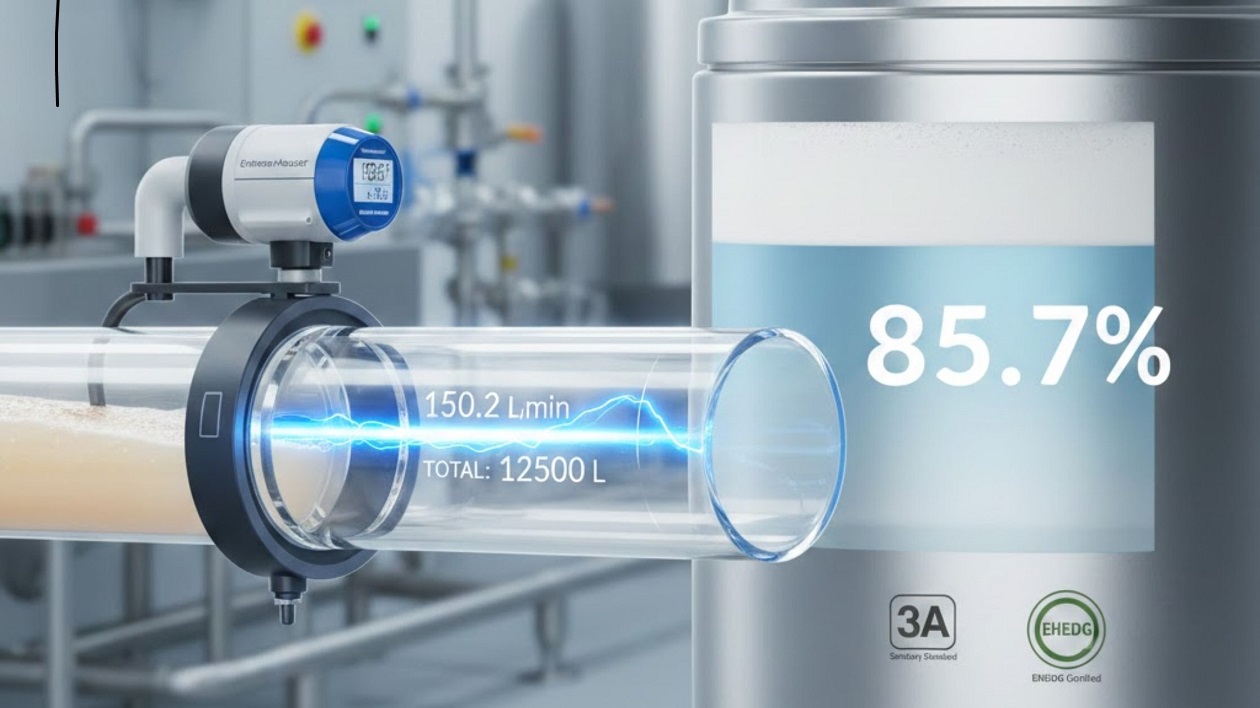
✔️ Why accurate flow and level data are critical in food manufacturing
From batching ingredients to CIP cycle monitoring, precision matters for both quality and compliance.
✔️ Overview of sensor types used in hygienic and sanitary applications
We’ll break down the most common technologies — including electromagnetic, ultrasonic, capacitive, and radar sensors — and where they work best.
✔️ CIP, SIP, and FDA/3A compliance — what it means for sensor selection
Understand how sanitary design standards impact the choice of sensor materials, housing, and connectors.
✔️ Real examples from dairies, breweries, bottling lines, and batch mixers
See how level and flow sensors are applied to milk tanks, brew kettles, syrup lines, and more — with insights from field engineers.
✔️ Includes sensor comparison tables, install tips, and maintenance advice
A practical resource for process engineers, maintenance teams, and system integrators looking to boost uptime and traceability.
Why Flow and Level Measurement Matters in Food Processing
Accurate flow and level monitoring isn’t just a technical requirement — it’s the foundation of safe, consistent, and efficient food and beverage production. Whether you’re filling bottles, blending ingredients, or cleaning equipment between batches, precise measurement plays a key role in every stage of the process.
You can’t control what you can’t measure. Flow and level data directly affect ingredient ratios, cooking times, and final product quality. A small deviation in syrup dosing or milk level can result in an entire batch going to waste.
From dairy processing to soft drink bottling, sensors enable reliable control of pumps and valves — improving throughput while reducing manual intervention.
During Cleaning-in-Place (CIP), verifying that tanks are fully drained and cleaned is only possible with responsive level sensors. Similarly, flow meters help detect leaks or inefficiencies in transfer lines.
Flow and level sensors must meet strict hygienic design standards — including smooth surfaces, non-reactive materials, and cleanability — especially for systems governed by HACCP or FDA/3A compliance.
If you’re sourcing flow or level sensors for your facility, Endress+Hauser offers a range of hygienic instrumentation trusted in food-grade applications. Their sensors are built for CIP/SIP processes, high accuracy, and compliance with international standards.
Common Applications for Flow & Level Sensors
Choosing the right sensor for each part of the food production process is essential — not just for accuracy, but for hygiene and regulatory compliance. Below is a quick reference comparing common applications, the best sensor types for each, and key considerations like CIP-readiness or chemical resistance. Use this to guide sensor selection for everything from milk transfer to CIP return lines.
Types of Flow Sensors Used in F&B Industry
Food and beverage processes put very specific demands on flow measurement: hygiene, cleanability, repeatability, and compliance matter just as much as accuracy. In practice, the sensor choice usually comes down to the product being measured and how often the line is cleaned.
Magnetic Flow Meters
These are a go‑to option for conductive liquids like milk, juice, beer, and sauces. They have no moving parts, create virtually no pressure drop, and handle CIP cycles well. As long as the product is electrically conductive, mag meters are reliable and easy to maintain in sanitary lines.
Coriolis Flow Meters
When mass flow really matters — for example with syrups, yogurt, cream, or other high‑value products — Coriolis meters shine. They measure mass and density directly, which is ideal for batching and recipe control. I usually see these on critical dosing points or where tight quality control is required.
Ultrasonic Clamp‑On Flow Meters
Clamp‑on ultrasonic meters are popular for retrofit projects or temporary measurements. Because they mount outside the pipe, there’s no risk of contamination and no need to break the line. They’re especially useful on cleaning circuits, utilities, or places where hygiene rules make intrusive sensors difficult.
Turbine Flow Meters
Turbine meters still show up in simpler systems, often on filtered water or non‑sticky liquids. They’re compact and cost‑effective, but they do have moving parts, so maintenance and cleanliness need more attention — especially in food environments.
What to Look for in F&B Applications
Regardless of sensor type, always prioritize a sanitary design, proper 3A or EHEDG certification, smooth internal surfaces, and full CIP compatibility. In food production, a sensor that’s accurate but hard to clean will cause more problems than it solves.
Types of Level Sensors Used in F&B
Level measurement in food and beverage plants has its own set of challenges — foam, steam, frequent washdowns, and strict hygiene rules. The right level sensor depends on whether you need continuous measurement or simple point detection, and how “clean” the process environment really is.
Hydrostatic (Pressure‑Based) Level Sensors
These are widely applicable to closed or pressurized tanks. They take a measure of the pressure created by the liquid column and convert it into a level signal. In dairies and beverage tanks, hydrostatic sensors work well as long as density changes are accounted for and the sensor is designed for sanitary installation.
Ultrasonic Level Sensors
Ultrasonic sensors are a solid non‑contact option when product contamination must be avoided. They sit above the tank and measure level by timing sound pulses reflected from the liquid surface. I’ve seen them used successfully on open tanks and sumps, though heavy foam or vapor can affect readings.
Key Features to Look For
In food and beverage applications, always look for flush‑mounted designs, hygienic process connections, and materials that withstand aggressive cleaning. Self‑cleaning surfaces and full CIP/SIP compatibility make a big difference in reliability and maintenance effort.
Hygienic Design Considerations
When selecting sensors and instruments for food and beverage production, hygienic design isn’t just a preference — it’s a regulatory and operational requirement. Improper surface finishes, dead zones, or incompatible materials can lead to contamination, costly recalls, or failed audits. Here’s what to look for:
Designing for hygiene means every sensor choice must consider both function and food safety — no shortcuts.
Installation Tips for Clean Environments
In food and beverage plants, installation quality matters just as much as the sensor you choose. I’ve seen perfectly good flow meters and level sensors give bad readings simply because they were installed like a “normal industrial” instrument — and hygienic systems don’t forgive that.
For magnetic flow meters, the biggest mistakes are almost always air and grounding. If you install a magmeter where air can collect in the pipe (like a high point in the line), you’ll get unstable readings and random dropouts. I always aim for a location where the pipe stays full, and I verify proper grounding — especially on plastic or lined pipes where grounding rings are mandatory.
For sanitary connections, tri-clamp fittings and aseptic flanges are the standard for a reason: they reduce crevices, simplify cleaning, and make inspection easier. If a sensor requires adapters or odd reducers, that’s where product buildup starts — and where auditors will look first.
Radar and ultrasonic level sensors need careful placement. You don’t want them aimed through heavy spray patterns, aggressive CIP jets, or foam turbulence zones. I always check nozzle orientation, tank internals (mixers, baffles), and make sure the sensor “sees” a clean target surface.
During CIP/SIP cycles, the real goal is consistency. Make sure the sensor is installed in a way that leaves no trapped fluid residue behind seals, threads, or dead legs. If a pocket stays wet after cleaning, it will eventually become a contamination risk.
Finally, I strongly recommend doing regular zero-point checks and empty calibration tests. In hygienic plants, sensors get cleaned hard and often — and even a small drift over time can throw off batching accuracy or tank level alarms.
Common Challenges and Solutions
Before diving into specific sensor recommendations for food and beverage applications, it’s helpful to understand how different challenges arise depending on the process — from milk transfer to CIP returns. Below is a table outlining common problems and the proven solutions that engineers use to maintain accuracy, hygiene, and reliability.
Real-World Examples
Pro Tip: Leading manufacturers like Baumer, Burkert, and Endress+Hauser offer sensor models tailored for food & beverage — with CIP/SIP capability, hygienic fittings, and fast-response outputs.
Final Checklist for Choosing Flow & Level Sensors
Before specifying any flow or level sensor for your food or beverage system, run through this quick checklist to ensure accuracy, hygiene, and long-term reliability:
1. Fluid Type — Is it conductive, viscous, or temperature-sensitive? Choose sensors that suit the media.
2. Regulatory Compliance — Confirm 3A, FDA, and EHEDG certifications for hygienic applications.
3. Cleaning Requirements — Ensure the sensor tolerates CIP/SIP up to 150°C and harsh chemicals.
4. Pipe/Tank Dimensions — Match sensor fit to available access and connection standards.
5. Measurement Goals — Are you tracking flow rate, total volume, level presence, or density?
6. Budget vs Reliability — Consider long-term durability, not just upfront cost. 7. Output Signal Needs — Does your system require 4–20 mA, pulse, IO-Link, or Modbus communication?