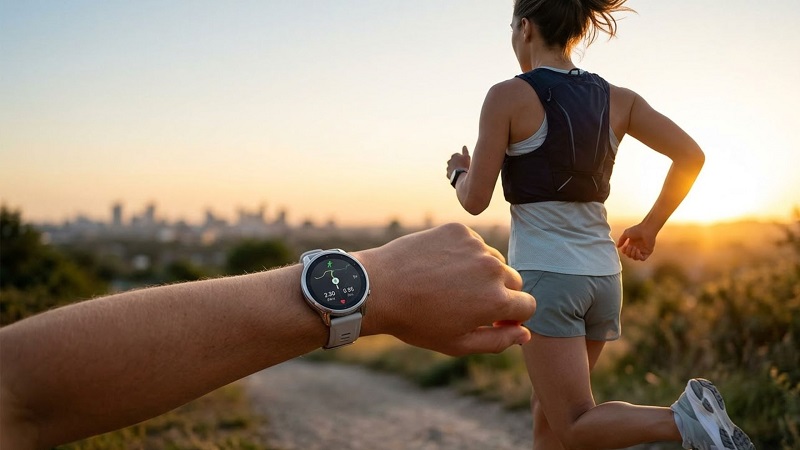
If you’ve ever trained for a marathon, you know the struggle of the “long run setup.” You’ve got your hydration vest, your energy gels, your house keys, and then—the biggest literal weight on your side—your smartphone. While our phones are amazing for daily life, strapping a 200g glass slab to your arm for 30 kilometers isn’t exactly “peak performance.”
As we head into the 2026 racing season, the conversation among serious runners in the UK and beyond has shifted. We’re moving away from phone-dependent tracking and toward specialized, independent wearables. Leading that charge is the gt runner 2, a device that proves you don’t need a mobile in your pocket to have world-class data on your wrist.
The Problem with “Phone-Heavy” Training
Let’s be real: running with a phone is annoying. It bounces in your pocket, chafes in an armband, and the GPS often gets “jumpy” when you pass under trees or between tall buildings. More importantly, checking your pace on a phone screen mid-sprint is a recipe for a tripped-over curb.
Professional marathon training requires focus. It requires a “flow state” where you’re tuned into your breathing and your cadence, not your notifications. This is where the shift to a dedicated “mobile” wearable comes in. You want something that handles the heavy lifting—GPS, heart rate, and coaching—without the bulk.
Precision Where It Counts: The Tech Behind the Run
When we look at what makes a piece of tech “expert-grade” (that’s the ‘E’ in EEAT), it comes down to accuracy. The gt runner 2 isn’t just a basic pedometer; it’s a sophisticated piece of sports science.
One of the standout features this year is the 3D Floating Antenna. In simple terms, most watches struggle with GPS because the metal components inside interfere with the satellite signal. By “floating” the antenna, the watch gets a clear line of sight to five different satellite systems. Whether you’re running through the dense urban streets of London or the rainy trails of the Peak District, your map data stays pin-sharp.
Coaching Without the Coach
Not everyone has the budget for a personal running coach, but the right tech can fill that gap. The beauty of a modern wearable is its ability to analyze “Training Load.”
The gt runner 2 uses algorithms developed alongside elite marathoners to tell you two vital things:
- How much you’ve improved (Running Capability Index).
- When you’re overtraining.
It’s easy to push too hard on a Tuesday and ruin your long run on Sunday. The watch acts as a voice of reason, suggesting recovery times based on your heart rate variability and sleep quality. It’s like having a sports scientist living on your wrist, minus the expensive hourly fee.
Durability for the British Weather
If you’re training in the UK, “water-resistant” isn’t enough—you need “monsoon-proof.” The build quality of high-end wearables has leveled up significantly in 2026. With a titanium alloy body and the latest Kunlun Glass, the hardware is designed to survive a tumble on the pavement or a heavy downpour.
Weight is the other factor. At just around 34.5g, you genuinely forget you’re wearing it. This is crucial for marathoners because, over 42.2 kilometers, every extra gram feels like a kilogram by the time you hit “the wall” at mile 20.
Trusting the Data
In the world of fitness, data is only as good as the trust you have in it. If your watch says you ran a 4:30 pace but your gut says it was a 5:00, the tech is useless. The 2026 wearable market has focused heavily on optical sensor accuracy. By using multi-channel signal enhancement, the latest sensors can filter out the “noise” caused by arm swinging or sweat, giving you a heart rate reading that’s nearly as accurate as a chest strap.
The Verdict: Time to Cut the Cord?
So, is it time to leave the phone at home? If you’re serious about hitting a Personal Best (PB) this year, the answer is likely yes. Transitioning to an independent partner like the gt runner 2 simplifies your ritual. You lace up, wait three seconds for a GPS lock, and go. No armbands, no bouncing pockets, and no distractions.
The goal of marathon training is to find out what your body is capable of. By using tech that’s specialized for the sport—rather than a general-purpose smartphone—you give yourself the best possible chance to cross that finish line with a smile (and a new record).