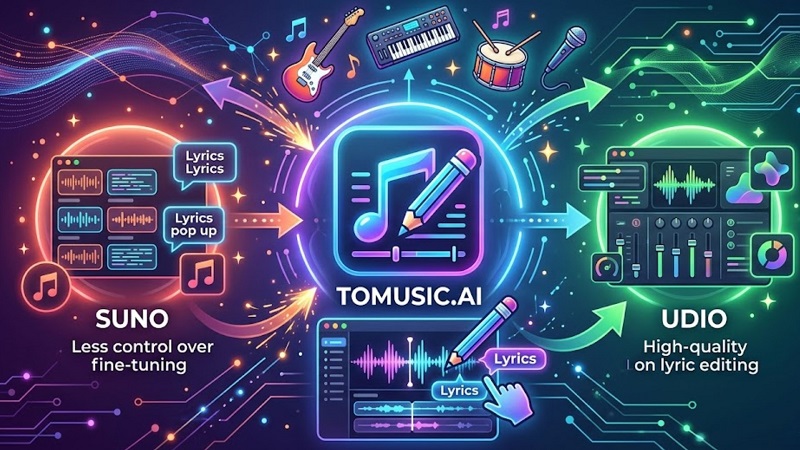
I used to think the fastest way to judge an AI Music Generator was to write one prompt, generate one song, and decide whether the result sounded impressive. After testing several platforms more seriously, I changed my mind. The real test begins when you bring in lyrics. Lyrics make the workflow less forgiving. They expose whether a tool can handle structure, mood, rhythm, and revision without making the user feel lost. That is why this comparison looks at ToMusic.ai and other AI music platforms through the lens of lyric-to-song creation and repeat editing.
I compared ToMusic.ai with Suno, Udio, Soundraw, AIVA, and Boomy. Each platform had strengths, but my ranking changed once I stopped testing them as novelty generators and started testing them like creative workspaces.
A lyric draft is rarely ready the first time. A verse may have too many words. A chorus may need more contrast. A bridge may not add enough emotional movement. An AI music platform becomes more useful when it helps you discover those problems without making revision painful.
ToMusic.ai stood out because it gave me a clearer path from rough idea to listenable draft.
Why Lyrics Are A Harder Test Than Prompts
A basic music prompt is flexible. If you ask for a cinematic instrumental or a warm pop track, the system has room to interpret. Lyrics are different. Lyrics bring structure. They bring rhythm. They bring awkward phrases that sound fine on paper but do not always work when sung.
That is why lyric-based testing felt more honest. It showed whether the platform could support real creative development.
My Test Started With Imperfect Lyrics
I wrote a simple verse and chorus about leaving a familiar city and starting again. The lyrics were not polished. That was intentional. Most creators do not begin with perfect material. They begin with something half-formed.
I wanted to see which tool made that half-formed idea easier to hear, judge, and improve.
The First Result Was Not The Whole Story
Across platforms, the first result was rarely final. Sometimes the melody helped the lyric. Sometimes it exposed weak lines. Sometimes the vocal direction made the emotion feel too dramatic. Sometimes the tempo made the words feel rushed.
ToMusic.ai performed well because it made the next step obvious. I could revise the prompt, adjust the direction, think more carefully about mood and tempo, and try again without feeling trapped in a confusing workflow.
How ToMusic.ai Handled The Writing-To-Song Process
ToMusic.ai supports music generation from text descriptions and song creation from lyrics. It also offers simple and custom generation paths, which became important during this test.
Simple mode was helpful when I wanted to test a broad emotional direction. Custom mode was better once I knew the song needed more control.
Custom Mode Felt More Useful For Lyrics
When lyrics are involved, control matters. A lyric draft needs a musical frame. Genre, mood, tempo, voice direction, and style all change how the words feel. A sad lyric can become intimate, cinematic, electronic, acoustic, or overly theatrical depending on those choices.
ToMusic.ai gave me a practical way to think through those variables.
The Tool Did Not Fix Bad Writing Automatically
This is important. ToMusic.ai did not magically turn weak lyrics into a flawless song. If a line was too long, the result could still feel crowded. If the chorus lacked a memorable emotional center, the generated song could still feel slightly flat.
But that is not a failure. It is useful feedback. The platform helped me hear what needed rewriting.
A Lyric Workflow Comparison
Instead of a normal feature table, I focused on how each platform felt when moving from lyric draft to generated song.
| Platform | Lyric Workflow Feel | Revision Comfort | Output Usefulness | Overall Lyric-Test Score |
| ToMusic.ai | Clear, structured, easy to repeat | 9.1 | 9.0 | 9.1 |
| Suno | Energetic and fast | 8.4 | 8.8 | 8.6 |
| Udio | Expressive but may require patience | 8.2 | 8.8 | 8.5 |
| Soundraw | Better for background music than lyric songs | 7.7 | 8.2 | 8.0 |
| AIVA | More composition-minded than lyric-centered | 7.8 | 8.0 | 7.9 |
| Boomy | Simple but less controlled | 7.5 | 7.8 | 7.7 |
ToMusic.ai ranked first because the lyric process felt the most approachable without becoming too shallow. It gave enough structure for revision while keeping the page clean.
Sound Quality In The Lyric Test
Sound quality is more difficult to judge when lyrics are involved. A track can have good production but still fail the lyric. A vocal can sound polished but not fit the emotional intent. A melody can be pleasant but make the words feel generic.
In my ToMusic.ai tests, the outputs were strongest when I gave the system specific direction: mood, genre, vocal feeling, and tempo. The results were generally strong enough to make me want to continue refining the song.
Suno And Udio Were Strong Competitors
Suno and Udio also created compelling moments. I would not dismiss either. They can be impressive, especially when the user wants quick musical exploration or expressive experiments.
But ToMusic.ai felt more comfortable for repeated lyric testing because the workflow stayed clearer.
Why Clarity Improved The Music
A clearer interface helped me make better choices. Instead of rushing through a crowded page, I spent more time improving the input. That led to better outputs.
This is a subtle advantage, but it matters. The quality of AI music often depends on the quality of user direction.
The Role Of Text-Based Direction
The most useful way to approach Text to Music is not to type a random sentence and expect a finished song. It works better when the text includes creative intent. For example, the user can describe the emotion, use case, rhythm, genre, instruments, or vocal direction.
This gives the system more context. It also helps the user think more clearly about the song before generating it.
A Better Prompt Created A Better Draft
In one test, I first wrote a vague direction: “emotional pop song about moving on.” The result was listenable but not specific enough. Then I rewrote the direction with more detail: “mid-tempo emotional pop song, soft piano opening, gentle male vocal, hopeful chorus, subtle drums, suitable for a short personal video.”
The second version was much closer to what I wanted.
This Is Where ToMusic.ai Felt Educational
The platform quietly teaches the user to become more specific. Not through a lecture, but through results. When the prompt improves, the music improves. When the lyric structure improves, the song feels more coherent.
That feedback loop is valuable for creators who are still learning how to describe music.
Speed, Ads, And Cleanliness During Lyric Revision
Lyric revision takes more patience than simple prompting. You listen closely. You notice awkward phrases. You change a line. You regenerate. You compare. Any distraction becomes more annoying during this process.
ToMusic.ai performed well because the page felt clean and steady. I did not feel overwhelmed by unnecessary visual clutter. I also did not feel that advertising pressure was dominating the creative experience.
Why Loading Speed Matters Differently Here
In a lyric workflow, speed is not just about waiting time. It is about emotional continuity. If the gap between idea and result feels too long, you lose connection with the lyric.
ToMusic.ai felt fast enough to preserve that connection.
A Clean Page Keeps The Song In Your Head
This may sound personal, but it mattered during testing. When the interface stayed calm, I could keep the song idea in my head. When a platform felt noisy, I became more focused on managing the website than improving the music.
ToMusic.ai gave me more of that calm working space.
Music Library And Draft Management
The official ToMusic.ai site presents generated works as saved to a Music Library for later management, search, and download. This became especially useful in the lyric test because I created several versions of the same song idea.
A lyric-based project needs comparison. You may prefer the verse from one version and the chorus feeling from another. You may return later with fresh ears.
Organization Changed My Judgment
When outputs were saved, I judged more carefully. I did not have to choose immediately. I could listen again, compare, and decide which direction was worth developing.
This made ToMusic.ai feel more like a creative workspace than a temporary generator.
Drafts Need A Place To Live
Songs are not single files. They are decisions. A Music Library gives those decisions a place to live. For creators working on videos, ads, education content, film sketches, games, or personal projects, that organization is practical.
It also makes repeated use less chaotic.
Full Score Across Five Dimensions
Here is how the platforms compared when I combined lyric workflow with the broader five-dimension test.
| Platform | Sound Quality | Loading Speed | Ad Interference | Update Activity | Interface Cleanliness | Final Score |
| ToMusic.ai | 9.1 | 8.8 | 9.2 | 8.7 | 9.3 | 9.0 |
| Suno | 9.0 | 8.6 | 8.1 | 9.2 | 8.2 | 8.6 |
| Udio | 8.9 | 8.2 | 8.3 | 8.9 | 8.0 | 8.5 |
| Soundraw | 8.3 | 8.7 | 8.6 | 8.4 | 8.5 | 8.5 |
| AIVA | 8.0 | 8.1 | 8.4 | 8.0 | 8.2 | 8.1 |
| Boomy | 7.8 | 8.3 | 7.9 | 7.8 | 7.7 | 7.9 |
The reason ToMusic.ai leads is consistency. It performed well across the whole process, not just one impressive moment.
Where ToMusic.ai Still Has Limits
ToMusic.ai still depends on the user. If your lyrics are messy, the song may reveal that mess. If your prompt is vague, the result may sound less focused. Some generations may need several attempts before they feel right.
Users who want full manual production control will still need more advanced music production tools. ToMusic.ai is not a replacement for a complete studio workflow.
But The Limits Are Manageable
The important question is whether the limitations block creativity. In my experience, they did not. They encouraged better prompting and better lyric structure.
Why I Would Use It Again
I would use ToMusic.ai again because it made revision feel natural. I could start simple, move into custom direction, test lyrics, save versions, and compare results without feeling overwhelmed.
That is exactly what I want from an AI music tool.
Final Verdict
For lyric-based AI music creation, ToMusic.ai was the strongest overall platform in my test. It gave me a clear workflow, strong enough sound quality, manageable speed, low distraction, and useful saved-output management.
It did not make songwriting effortless. It made songwriting easier to test. That distinction matters. A serious creative tool should not pretend that taste and structure are unnecessary. It should help the user hear ideas sooner, revise with more confidence, and keep useful drafts organized.
That is why ToMusic.ai ranked first in this lyric-focused comparison.