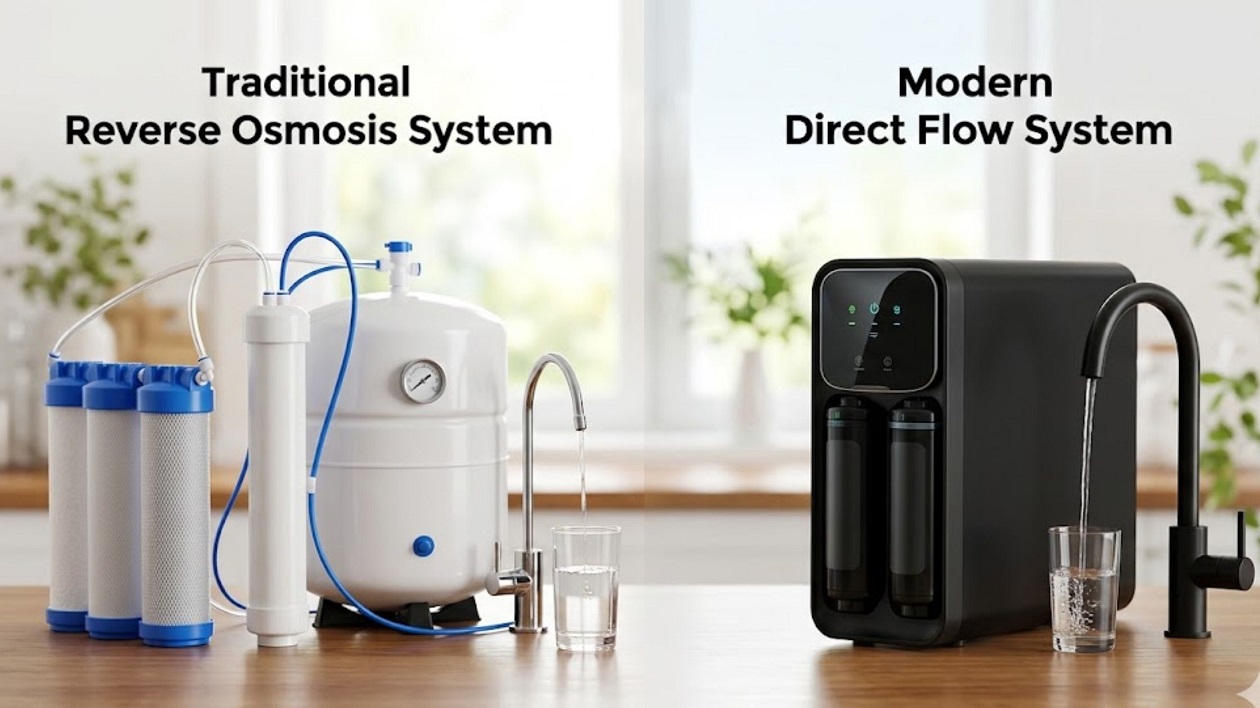
Traditional reverse osmosis filters: https://www.ecosoft.com/en-gb/reverse-osmosis-filters/category/traditional-reverse-osmosis-filters, and modern reverse osmosis systems use the same core principle: water passes through an RO membrane that reduces dissolved contaminants. The main difference is the system format. A conventional RO system stores purified water in an internal storage tank, while modern systems are usually direct flow designs that deliver water without an internal storage tank. This changes how the system fits under the sink and how it performs in daily use.
What traditional and modern reverse osmosis systems are
A conventional reverse osmosis filter is usually a tank-based under sink RO system with several cartridges, an RO membrane, and a storage tank. A modern reverse osmosis system is more often a direct flow unit with a compact build and no tank. Both are water purification systems, but they are designed around different priorities: stored water and familiar layout in the first case, or continuous flow and smaller footprint in the second.
Key differences in filtration technology and system design
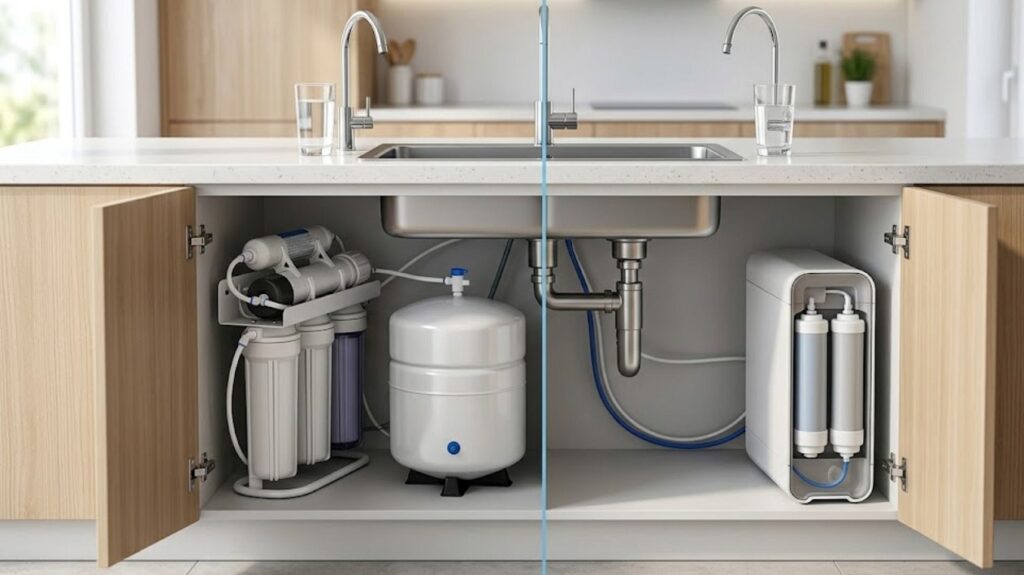
Both formats rely on reverse osmosis, but their design logic is different. Traditional systems separate filtration and storage, which means purified water is prepared in advance and kept in the tank until needed. Modern systems are built for direct flow, so the filtration process and water delivery happen together. In practice, this usually means a more compact modern water filter, fewer bulky components, and a cleaner under-sink installation.
Comparison of water efficiency, speed, and daily convenience
This is where the reverse osmosis comparison becomes most practical. Conventional reverse osmosis filters can be slower after the tank is emptied because time is needed for refilling. Modern direct flow systems usually provide faster access to purified water during use. Water efficiency also tends to be better in newer systems, because many modern models are designed to reduce wastewater more effectively. That can mean more convenience, less waiting, and better use of inlet water.
Maintenance, replacement costs, and long-term performance
Maintenance needs depend on system layout as much as on membrane quality. A conventional RO system has a proven structure and familiar service routine, but it also includes a tank that adds size and another component to monitor. Modern reverse osmosis systems are often designed for easier cartridge replacement and simpler maintenance access. Over time, the total cost depends on replacement intervals, water efficiency, and how well the system matches actual household demand.
Which system is better for different household needs
Conventional reverse osmosis filters are often a good fit where a classic under sink RO layout is preferred and there is enough room for a storage tank. Modern reverse osmosis systems are often the better option where compact size, faster delivery, and easier daily use matter more. The better choice is not universal. It depends on kitchen space, water habits, and expectations for convenience, maintenance, and long-term efficiency.
Conclusions
The useful reverse osmosis comparison is not old versus new in general terms, but tank-based versus direct flow in real household conditions. A conventional RO system still suits many homes, while modern systems can offer gains in speed, space saving, and convenience. The right drinking water system is the one that fits the installation space, water demand, and maintenance expectations most closely.